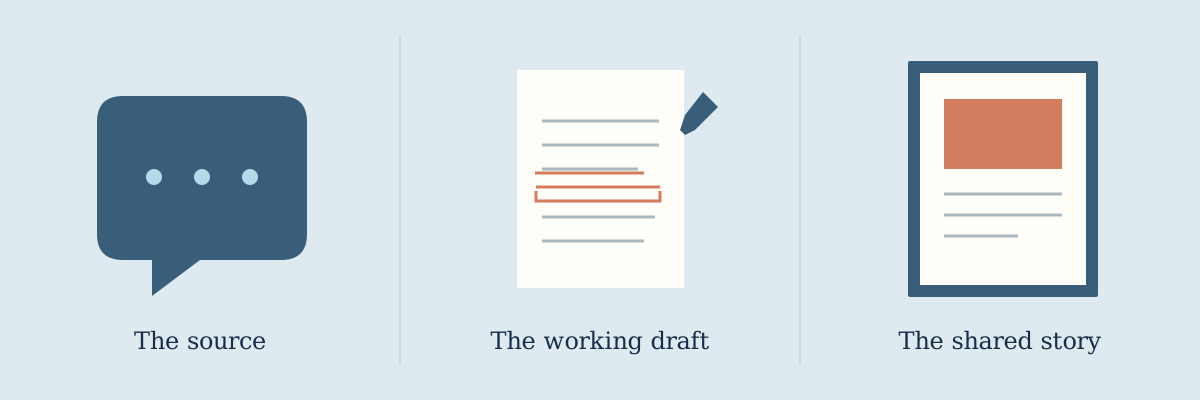
Start with what
someone actually said.
A personal-story concept could begin with an agreed topic and a willing participant. An interview tool could begin with a recording the user is entitled to work with. A fiction tool would instead start from material explicitly marked as invented.
The product brief should identify what counts as the source, where it is kept and how a user can return to it. A lander cannot establish storage, security or long-term preservation merely by describing them.
Make the editing
visible enough to review.
A proposed interview workspace could connect a selected passage to its place in the source, keep editorial notes and offer an outline for a person to revise.
If AI suggestions are introduced, the product would need to distinguish them from the speaker’s original words. A polished paragraph is not, by itself, evidence that it accurately represents an interview.
A personal collection could use the same distinction on a smaller scale: original material beside the edited version, with a deliberate review before sharing.
Choose who the story
is being made for.
A private family collection, a public podcast and a fictional scene have different audiences and expectations. A future product should give people clear choices about intended use, access and presentation.
The first offer can be narrow: one reviewed interview chapter, one episode outline or one dialogue scene. That gives TalkTale a concrete beginning without claiming to preserve every story forever.
About this perspective
This page is original naming and product commentary. It is not a technical specification, legal guidance or evidence of therapeutic, educational or commercial outcomes. No recording, transcription or publishing service is operated here.